
From the Journal
The Best Time of Year for a Wellness Retreat, Region by Region
Almost every region has two good windows and one to avoid, and they rarely line up with school holidays or with when people think about booking.
The pattern that holds nearly everywhere is that shoulder season wins. The weeks either side of peak are quieter, cheaper, and usually more pleasant to practise in. Peak summer in the Mediterranean and peak winter in the tropics are the seasons that cost the most and deliver the least comfort.
Here is how that plays out across the regions we work in.
Africa
Morocco
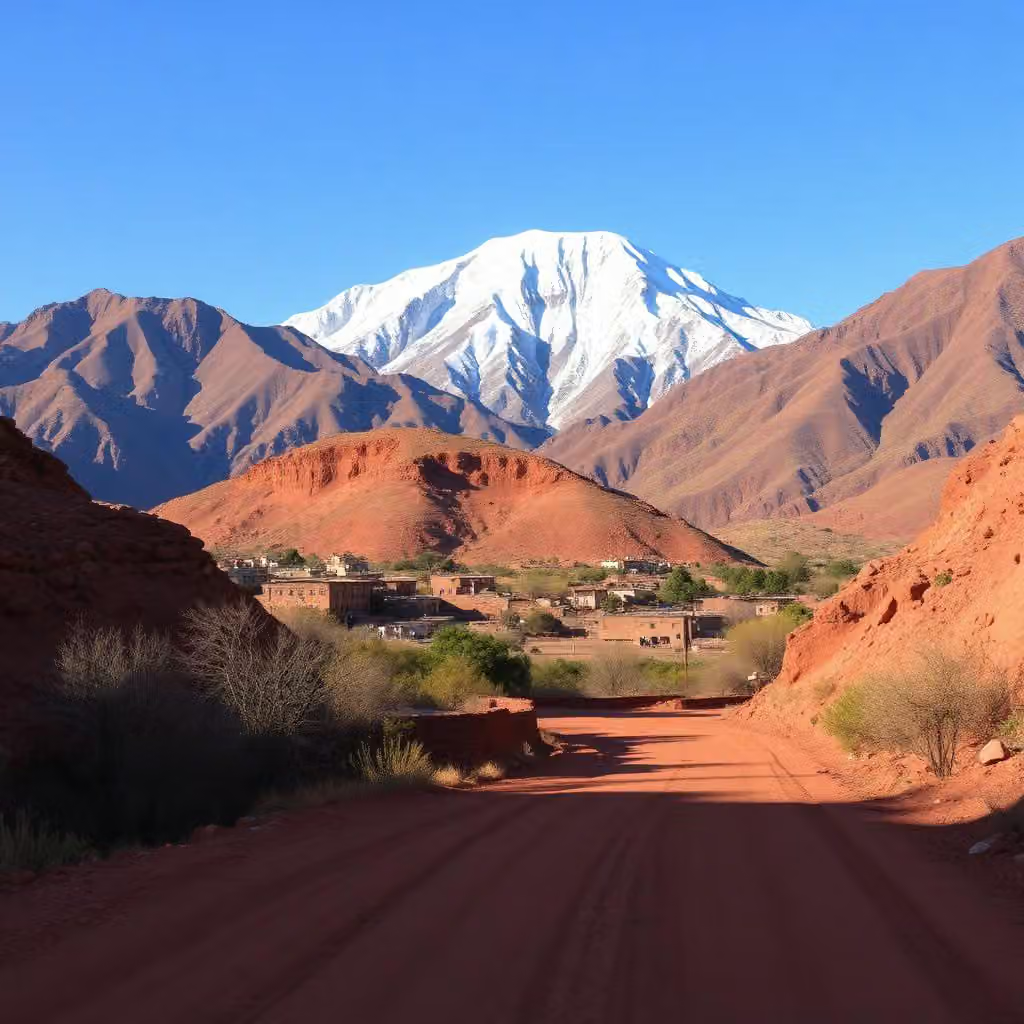
Best in spring, roughly March to May, and autumn, September to November. Both give you warm days, cool nights, and the Atlas Mountains at their most walkable.
Avoid high summer inland. Marrakech in July and August is genuinely hot, and while the Atlas foothills offer relief, they do not offer escape. Essaouira on the coast stays cooler all year because of the Atlantic wind, which is why it often ends a summer itinerary.
Winter is mild on the coast and cold at altitude. It can be lovely if the itinerary is built for it. See Morocco retreats for how the two itineraries differ.
Botswana
The dry season, May to October, is the season. Water sources shrink, wildlife concentrates around what remains, and game viewing gets better as the months go on, peaking around July to October.
There is a second consideration in the Okavango: the annual floodwaters arrive months after the rain that caused them, and the delta is typically at its fullest around June to August. That is when water-based activities such as mokoro canoeing are at their best, which matters for a safari retreat built around stillness on water.
The green season, November to April, brings rain, dramatic skies, excellent birding and much lower prices, with thicker vegetation and harder game spotting. It is a real option if wildlife is not the whole point.
Namibia
May to October, for the same dry-season reasons, with the added benefit that the desert is bearable. Cool mornings at Sossusvlei are the difference between a memorable dune walk and an ordeal.
Nights get genuinely cold in June and July, which surprises people packing for a desert. December to March is hot, with occasional dramatic rain that can turn the landscape briefly green. Namibia retreats sit in the cooler window for good reason.
Asia
India
October to March, without much argument. The monsoon runs roughly June to September and the pre-monsoon months of April and May are extremely hot across the north.
For an itinerary combining the Golden Triangle with Ranthambore, there is an operational point worth checking as well as a weather one: Ranthambore's core zones usually close during the monsoon, roughly July to September. Confirm current dates when you plan, because they shift.
November to February gives you the most comfortable days and, in Rajasthan, cold early mornings. See India retreats for the shape of the week.
Bhutan
Two clear windows. Spring, March to May, brings rhododendrons and warmer valleys. Autumn, September to November, brings the clearest mountain views and most of the major festivals.
The monsoon runs June to August, with cloud that often hides exactly the views you came for. Winter is cold but bright at lower altitudes and very quiet, which some people prefer. Bhutan rewards the autumn window if you can take it.
Europe
Portugal
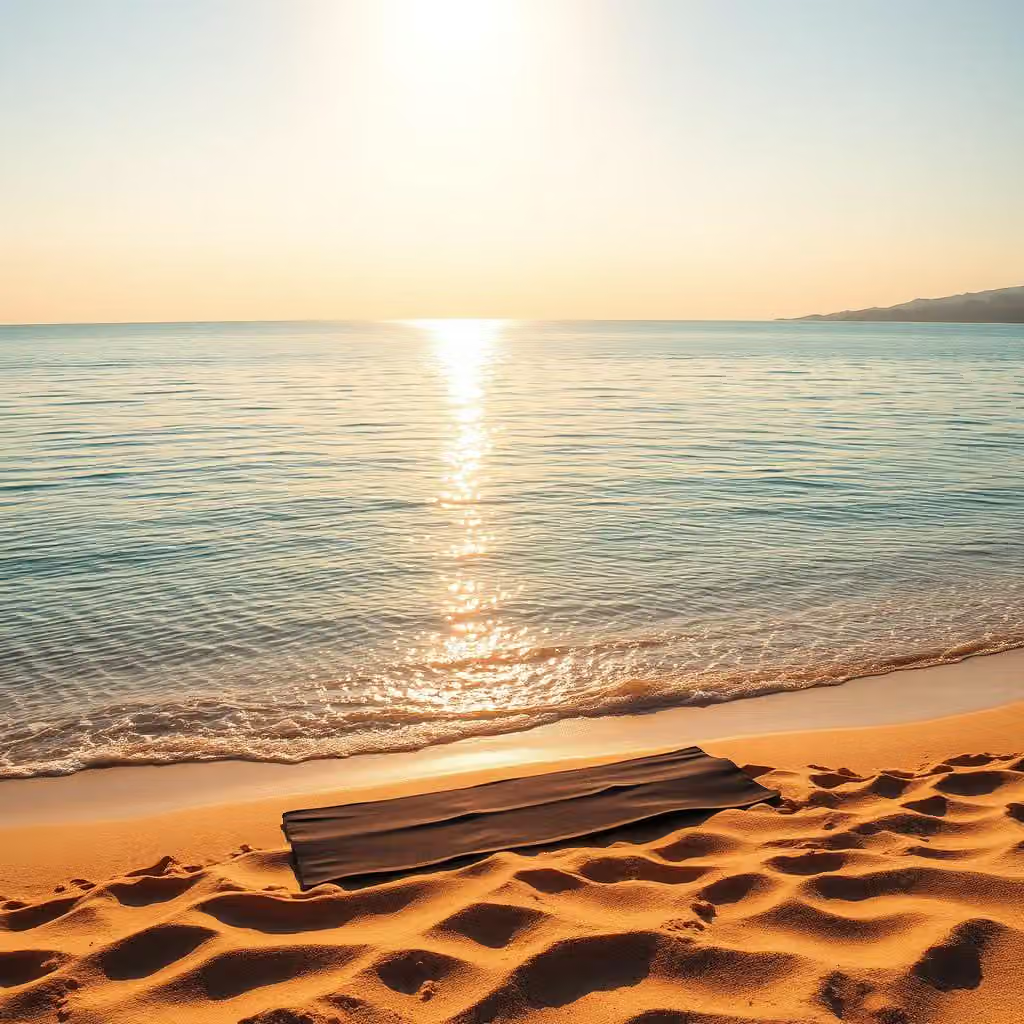
April to October works nearly everywhere on the mainland, and late September is arguably the best fortnight of the Portuguese year: warm sea, thinning crowds, softer prices.
The Azores are their own case. Mild year-round, wetter than the mainland, and greenest for it, with the most settled weather roughly June to September. Expect changeable days whenever you go, which is part of the character of the Azores. Inland Sertã is hotter and drier in summer than the coast.
Spain
It depends which Spain. The Mediterranean islands and the Costa Brava are at their best in May to June and September to October. July and August bring heat, crowds and peak pricing.
Tenerife is the outlier. Subtropical and reliable more or less year-round, which makes the Canaries the one part of Spain worth considering in midwinter. The Costa Blanca around Benidorm also has notably mild winters.
Croatia, Greece and Italy
All three follow the same logic: May to June and September to October, and avoid August if you can.
Croatia in August means crowds along the Dalmatian coast and prices to match. In the Cyclades, Paros contends with the meltemi, a strong summer wind that peaks in July and August and can disrupt ferries and outdoor practice. Sicily is very hot in July and August and beautiful in April, May and October.
Central America

Costa Rica
The dry season, December to April, is the reliable window, particularly on the Pacific side where Salt and Sound sits.
The green season, May to November, is cheaper and greener, with rain that often arrives predictably in the afternoon rather than ruining whole days. September and October are the wettest months on the Pacific coast and the ones to approach with caution. Costa Rica in early December is a quiet sweet spot.
Dominica
February to May is the driest and most settled window, and the one to aim for.
The Atlantic hurricane season runs officially from 1 June to 30 November, with activity concentrated between mid-August and mid-October and a statistical peak around 10 September. That does not make a September retreat impossible, but it does make travel insurance with cancel-for-any-reason cover essential rather than advisable. Dominica is at its greenest after the rains, which is part of why the island is called the Nature Isle.
Panama
The Pacific dry season runs December to April, but Bocas del Toro sits on the Caribbean side and does not follow it.
The Caribbean coast has its own rhythm, with brighter spells tending to fall around February to March and again around September to October, and wetter periods either side. This is the destination where it is most worth asking about specific weeks rather than trusting a national dry season. Panama rewards that question.
North America
Sedona, Arizona
Spring, March to May, and autumn, September to November. Both give you warm days, cold nights and red rock at its best in low light.
Summer is hot, though less brutal than Phoenix because of the altitude, and July and August bring the southwestern monsoon with dramatic afternoon storms. Winter is cold and can bring snow onto the rocks, which is spectacular and limits the hiking. Vortex Flow Sedona is built for the shoulder months.
The short version
January to March. Tenerife, the Costa Blanca, Costa Rica, Panama's Pacific side, India, Dominica from February. Morocco from March.
April to June. Morocco, Bhutan in spring, Portugal, mainland Spain and the Balearics, Croatia, Greece, Sicily, Sedona, Botswana and Namibia as the dry season opens, the Okavango filling.
July and August. The hardest months across most of the range. Botswana and Namibia are excellent, and the Azores are settled. Nearly everywhere in the Mediterranean is hot, crowded and expensive.
September to November. The strongest overall window. Morocco, Bhutan in autumn, all of southern Europe, Sedona, Botswana and Namibia through October, India from October. Approach the Caribbean with insurance until December.
Why shoulder season is also cheaper
Villas and boutique properties price by demand, and their quiet weeks are negotiable in a way their peak weeks are not. For a retreat leader that difference goes straight to your margin or lets you offer a lower price without losing anything, which is worth reading alongside the cost structure of a retreat.
It usually means better staff attention too. A villa hosting one group instead of turning over three in a fortnight is a different experience.
Before you fix dates
Check the current travel advisory and entry requirements for your destination before you book flights, since passport validity rules catch more people out than visas do. Practical references sit on our resources page.
Then look at where we go. If your dates are fixed and you want to know which destinations suit that window, tell us the weeks and we will tell you honestly what works and what we would avoid. If you are choosing between two places, Morocco or Portugal compares the pair most first-time leaders weigh up.
Essential inquiries

Planning a retreat of your own?
Tell us about your group, your dates and the feeling you want the week to have. We will tell you honestly what it takes, what it costs, and where we would send you — even when the answer is somewhere we do not run.
- A real conversation, not a sales call
- Honest costing before you commit
- Itineraries shaped around your people